First, it taught itself
It played about 7,000 full simulated matches an hour on one Mac, on a physics simulator it is not allowed to change, and learned routes for each kind of partner.
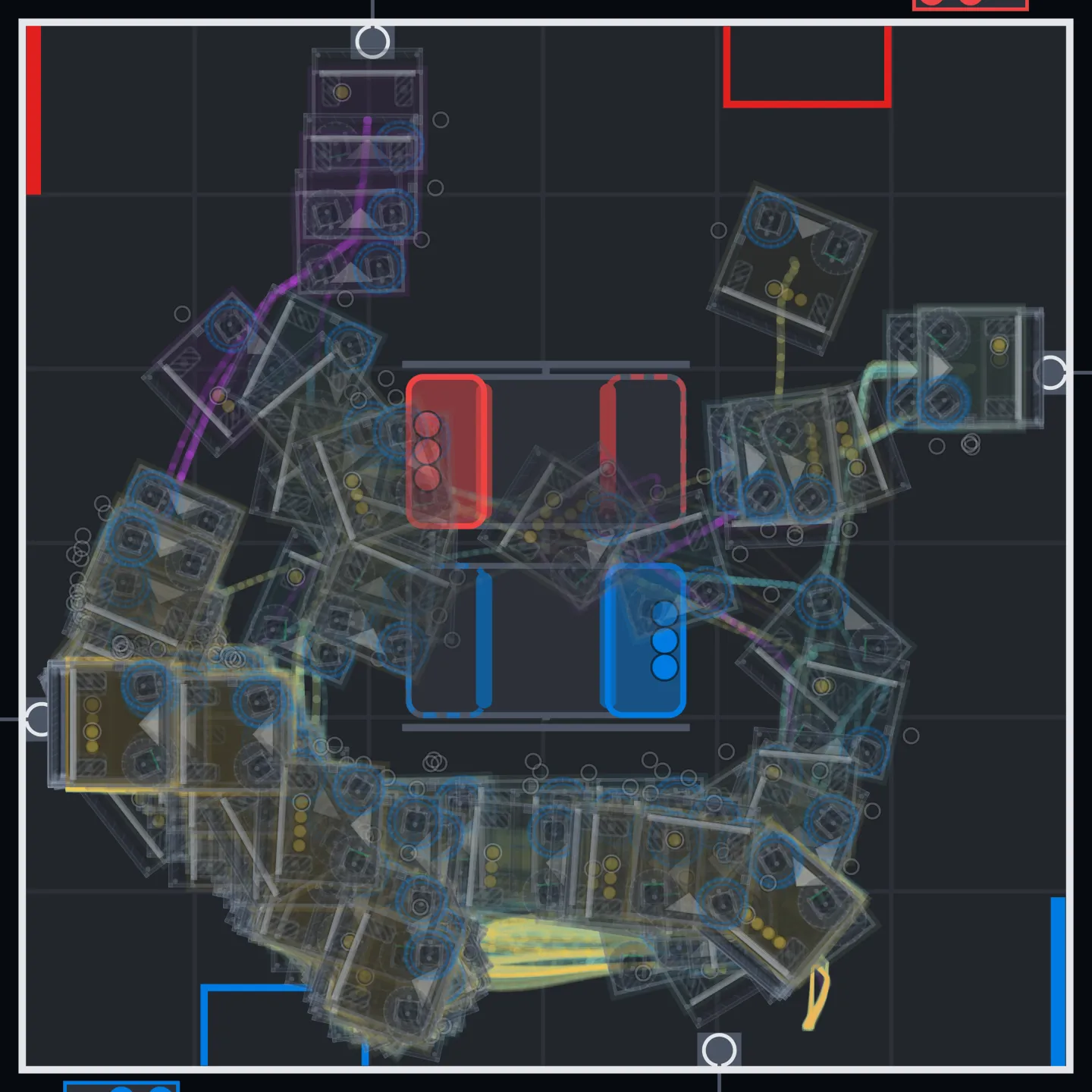
A strategy tool for BIOBUZZ that first taught itself by playing thousands of simulated matches, then was rebuilt to try every combination of our robots' plans, to find the best plan for each kind of alliance partner.
In FTC, strategy usually comes down to guessing: which elements to collect, where to shoot, how to share the field with a partner. There are far too many combinations to try with a real robot.
Learning Studio began as an AI that taught itself by playing thousands of simulated BIOBUZZ matches an hour. We then rebuilt it so that nothing is learned: each robot plays its pre-coded skills, and the studio plays every combination of their plans and ranks them for each kind of alliance partner.
In training, its newest search scored 27.8 more points than our previous approach across 24 paired test matches. The exhaustive search then ranked all 24 scenarios from 383,782 simulated plays: beside a second robot like ours with no opponents, its best plan scored 20.8 more points a match than the robots' own order, on the same 32 draws.
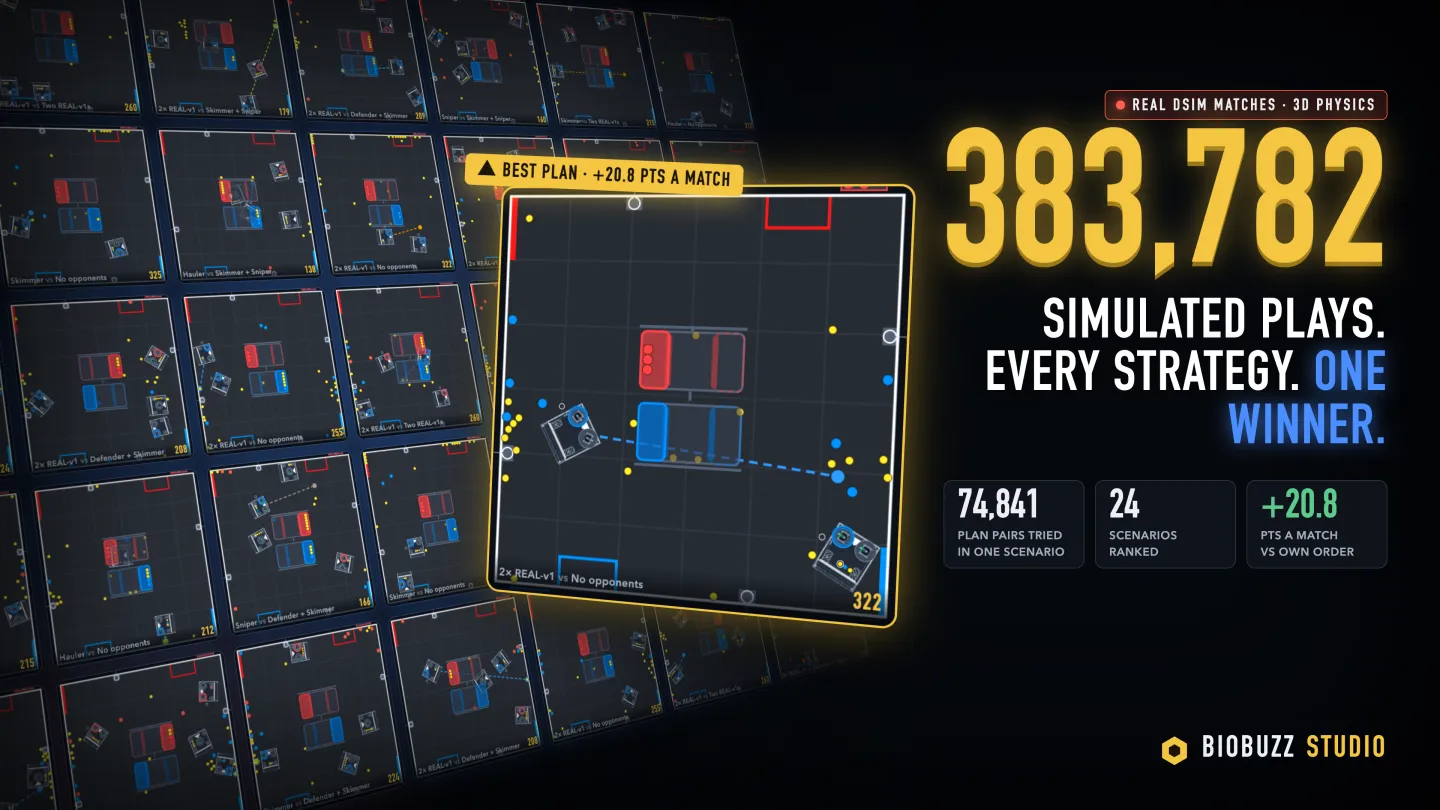
It played about 7,000 full simulated matches an hour on one Mac, on a physics simulator it is not allowed to change, and learned routes for each kind of partner.
We replaced the learning with an exhaustive search. Each robot plays its pre-coded skills, and the studio plays every combination of autonomous sequences, driver-controlled loops and last-30-second moves in the same simulator, with the same luck for every plan.
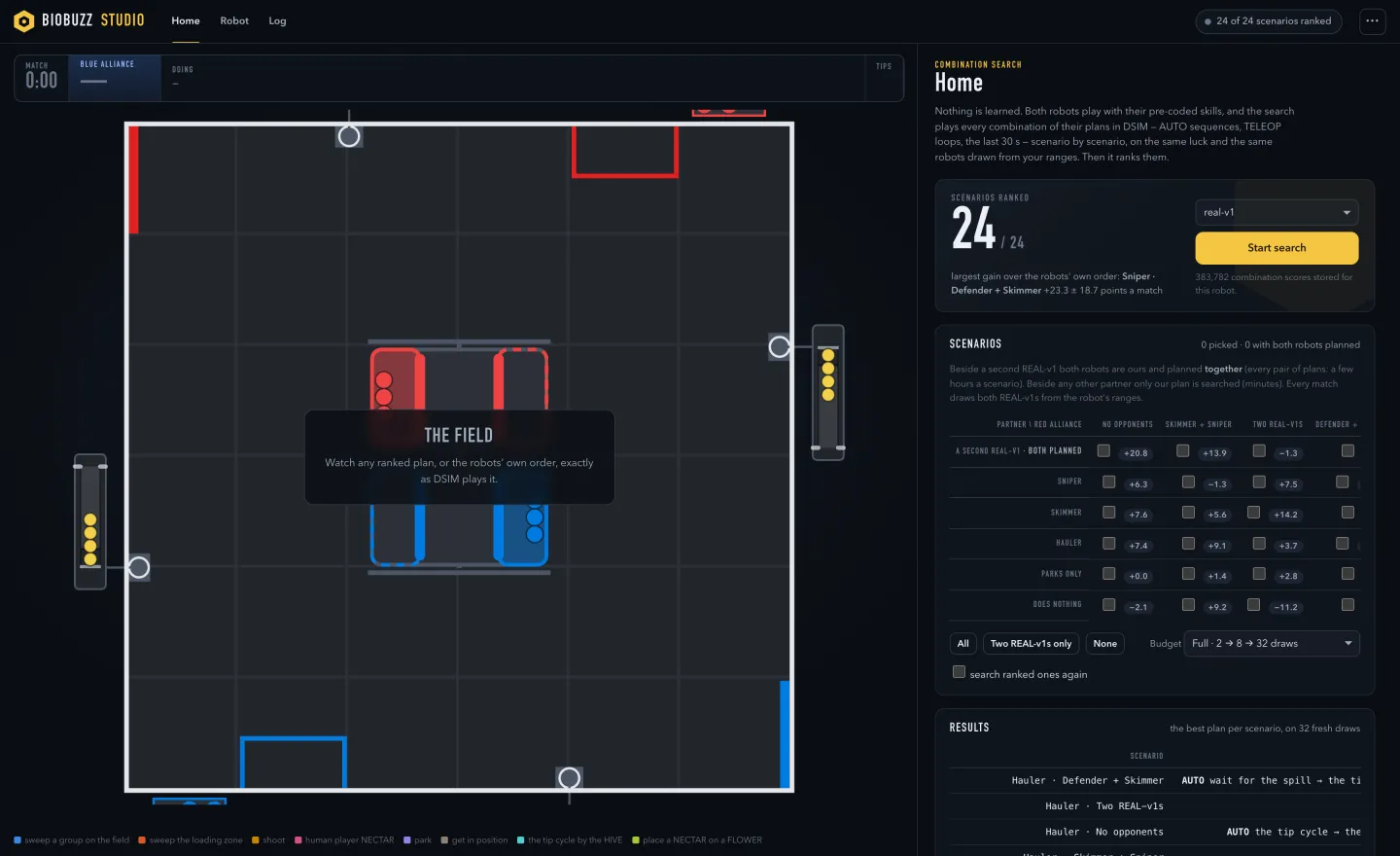
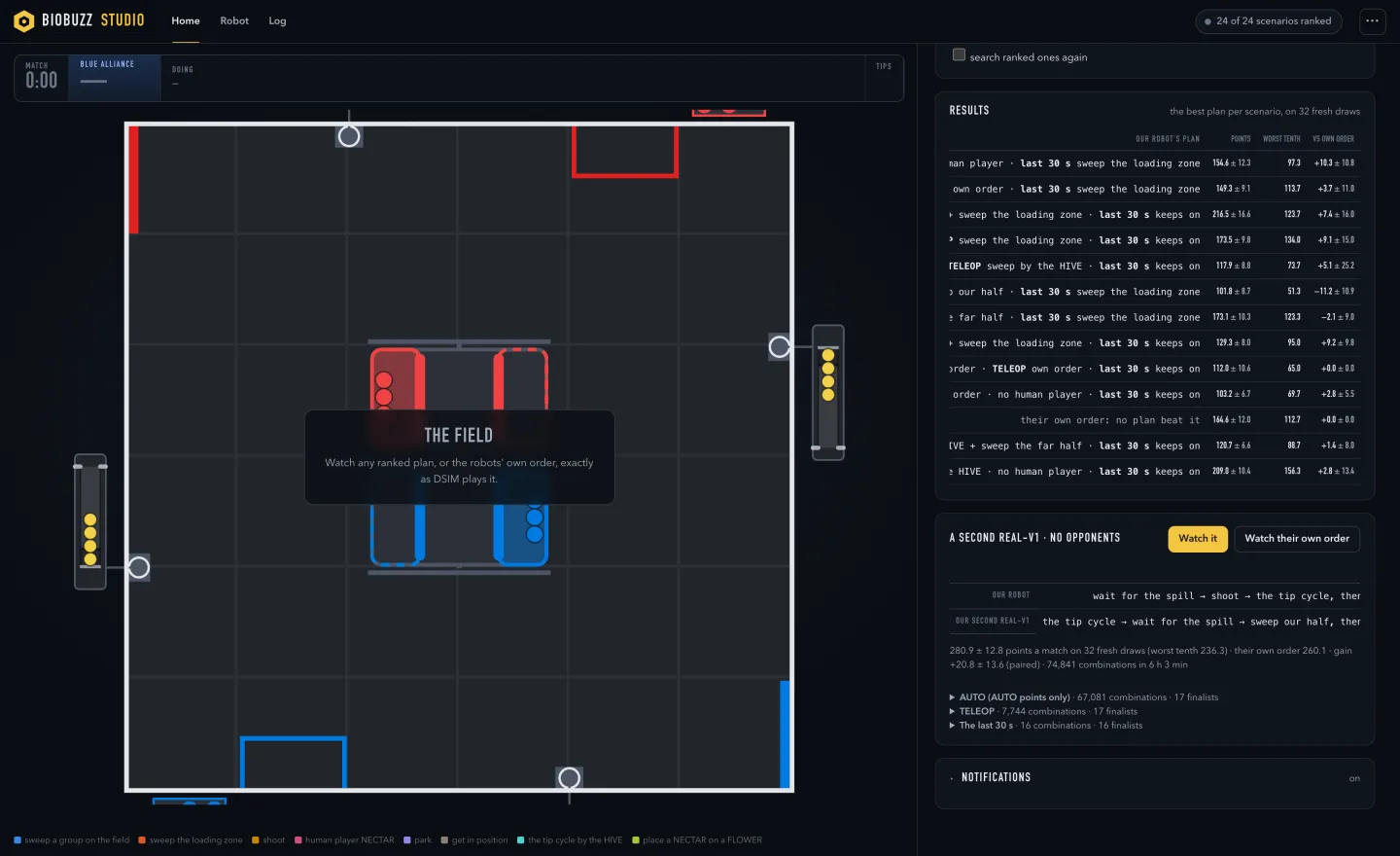
Each of the 24 scenarios, a kind of partner against a red alliance, gets a best plan for both robots, judged by its average score and by its worst tenth of matches.
If the AI could change the simulator, it could learn to win against the simulator instead of the game. Keeping the physics untouched is what makes its strategies worth anything.
A plan that scores well on average but falls apart one match in ten is a risk in a real event. Ranking plans by their worst games as well as their average picks strategies we can rely on.
To know whether a new method is really better, both versions played the same test matches with the same luck. Without that, a lucky run can look like progress.